


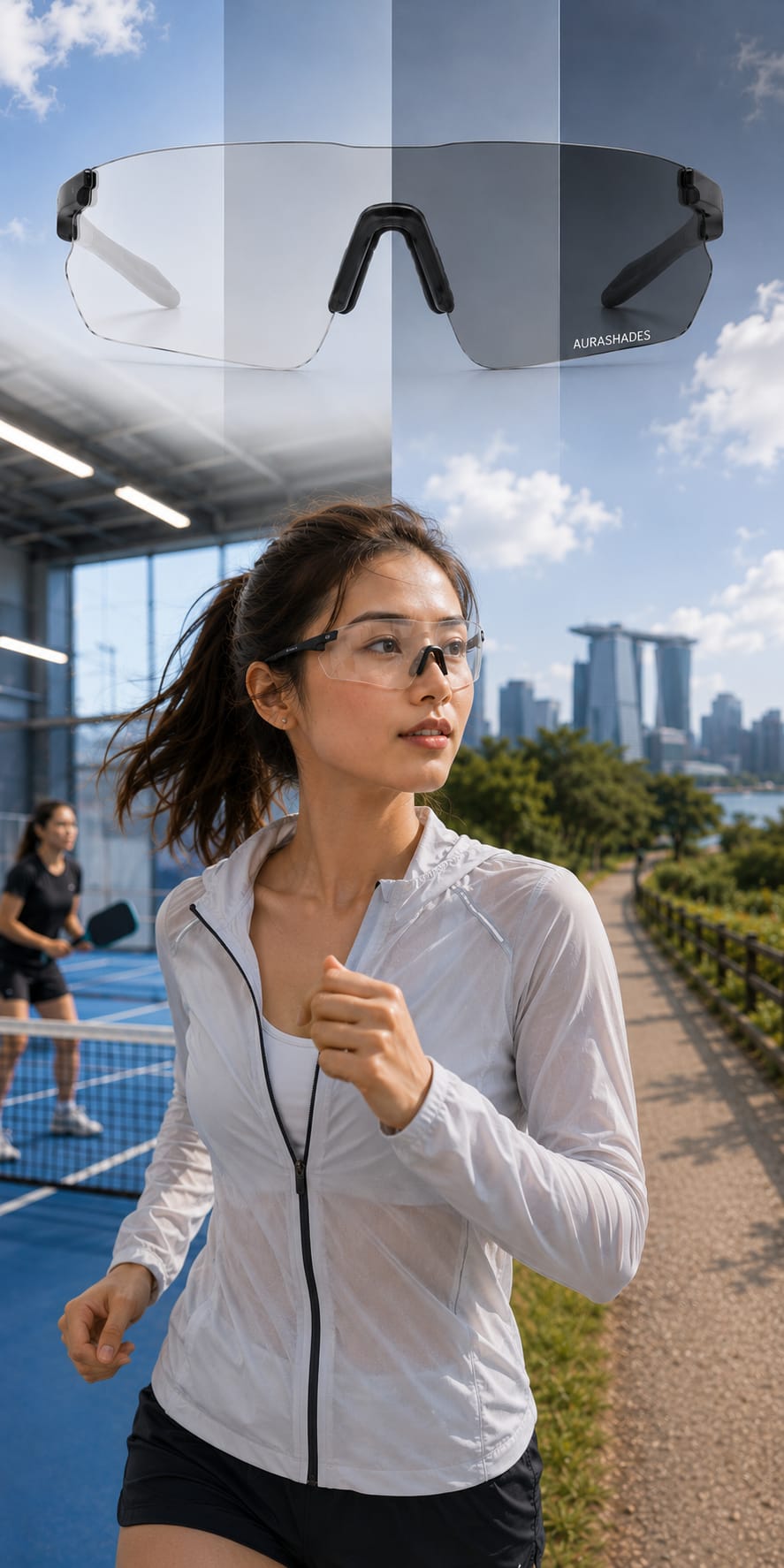
Yes, you still need sunglasses on a cloudy day in Singapore. Clouds block a lot of the light you can see, but much less of the UV you cannot. The World Health Organization notes that up to 80 percent of solar UV radiation can pass through light cloud cover, so a grey monsoon afternoon can still put real UV into your eyes. The catch is that cloudy days feel safe, so people leave their sunglasses at home exactly when they are not paying attention. For real sunglass UV protection, wear a pair labelled UV400 or 100 percent UV protection whenever you are outdoors for more than a few minutes, sun or cloud. If the light keeps changing, a photochromic lens that adjusts on its own is the easiest fix.
In this article
- Do clouds block UV rays?
- Is UV still high in Singapore during the monsoon?
- Does a darker lens mean better UV protection?
- Which lens works best on cloudy days?
- How do the lens types compare?
- FAQ
Do clouds block UV rays?
Some, but far less than you think. Thick, dark storm clouds cut UV a lot. Thin or broken cloud, the kind Singapore gets most days, lets most of it through. Broken cloud can even bounce UV around and push levels up for short spells, according to the WHO's guide to UV levels.
Here is the problem. Your eyes judge brightness, not UV. On a dull day you squint less and your pupils open wider, so more of whatever UV is around gets in. That is why "it's cloudy, I don't need sunglasses" is one of the most common mistakes we hear.
Is UV still high in Singapore during the monsoon?
Often, yes. The Northeast Monsoon runs from about December to early March. It brings more rain and cloud, but the days between showers are still tropical. Singapore sits close to the equator, so the sun is high overhead all year and midday UV can be high even when it does not feel hot.
A typical December day goes like this: bright morning, clouds building by lunch, a heavy afternoon shower, then sun again. If you are out for a run, a walk at the Botanic Gardens or a beach day before the year-end break, you can move through all of those in two hours. A pair that only works in full sun means you either take it off and get no protection, or keep it on and struggle to see.

Does a darker lens mean better UV protection?
No. Tint and UV protection are two different things. A dark lens with no UV filter is worse than wearing nothing, because your pupils open wider behind it and let more UV in. A clear or light lens with a UV400 filter protects you fully. The American Academy of Ophthalmology makes the same point: choose sunglasses that block 100 percent of UVA and UVB, and do not judge them by colour or price.
This matters most on cloudy days, when a lighter lens is more comfortable. You do not have to wear a dark lens to stay protected. You just need the UV400 rating. For more on the common mix-ups, read our post on 5 sunglass UV protection myths.

A photochromic carbon fibre pair that starts almost clear and darkens as UV rises, so you can keep it on all day.
Which lens works best for sunglass UV protection on cloudy days?
It depends on how much the light changes during your day.
- Photochromic: best for changing light. The lens reacts to UV, not brightness, so it darkens when UV is high, even under cloud. It is ideal for runs, rides and long outdoor days that start early and finish late.
- Polarised: best for glare. Wet roads, puddles and the sea all throw glare after a monsoon shower, and polarised lenses cut it. Polarisation does not add UV protection by itself, so check the UV400 rating as well.
- Photochromic and polarised together: the most complete option if you are outdoors for hours and want one pair that does both jobs.
One honest note: most car windscreens block UV, so photochromic lenses darken less while you drive. If you mainly need sunglasses for driving, a polarised lens is usually the better buy.

Photochromic and polarised in a carbon fibre frame. It adjusts to cloud and sun and cuts the glare off wet roads.
How do the lens types compare?
| Lens type | Cloudy day | Full sun | Wet road glare | Our pick |
|---|---|---|---|---|
| Standard tinted (UV400) | Protected, can feel too dark | Good | Little help | Fine for short trips |
| Polarised (UV400) | Protected, can feel too dark | Very good | Best | You Had Me at Pink, Disco Pigeon Takes Flight |
| Photochromic | Best, stays light | Good, darkens in UV | Little help | 67 Shades of Grey |
| Photochromic and polarised | Best | Very good | Best | Blinded by My Own Greatness |

What if I just want one everyday pair?
Pick a polarised pair with a UV400 rating and wear it every time you head out, not only when the sun is blazing. A pair you actually carry beats a premium pair left at home. Keep it in your bag through the monsoon so you are covered when the sun breaks through between showers.

A polarised OG pair at our lowest price, light enough to live in your bag all season.

A polarised X collection pair that handles sea glare and trail days before the year-end break.
Frequently asked questions
Can you get UV damage to your eyes on a cloudy day?
Yes. Light cloud lets most UV through, and you are more likely to skip sunglasses when it is dull. Long-term UV exposure is linked to cataracts and other eye problems, so wear UV400 lenses whenever you are outdoors for a while.
Do photochromic lenses work when it is cloudy?
Yes. Photochromic lenses react to UV, not to visible brightness. If UV is getting through the cloud, the lens will darken to match. On very dull days it stays light, which keeps your view clear.
Do polarised sunglasses give UV protection?
Not on their own. Polarisation cuts glare. UV protection comes from a separate filter, so look for a UV400 or 100 percent UV protection label on any polarised pair.
Is UV400 the same as 100 percent UV protection?
Yes, in practice. UV400 means the lens blocks light up to 400 nanometres, which covers both UVA and UVB.
When is UV highest in Singapore?
Usually from late morning to mid afternoon, roughly 11am to 3pm, when the sun is highest. Check the UV index on the NEA website or myENV app before long outdoor sessions.
One pair for sun, cloud and everything between
Browse our photochromic range, built for Singapore days that change by the hour.
Shop photochromic sunglasses →Not sure which lens suits you? Email hello@aurashades.co and we will help.
Share:
Sunglasses Near Me in Singapore: Where to Buy and What to Check First (2026)