


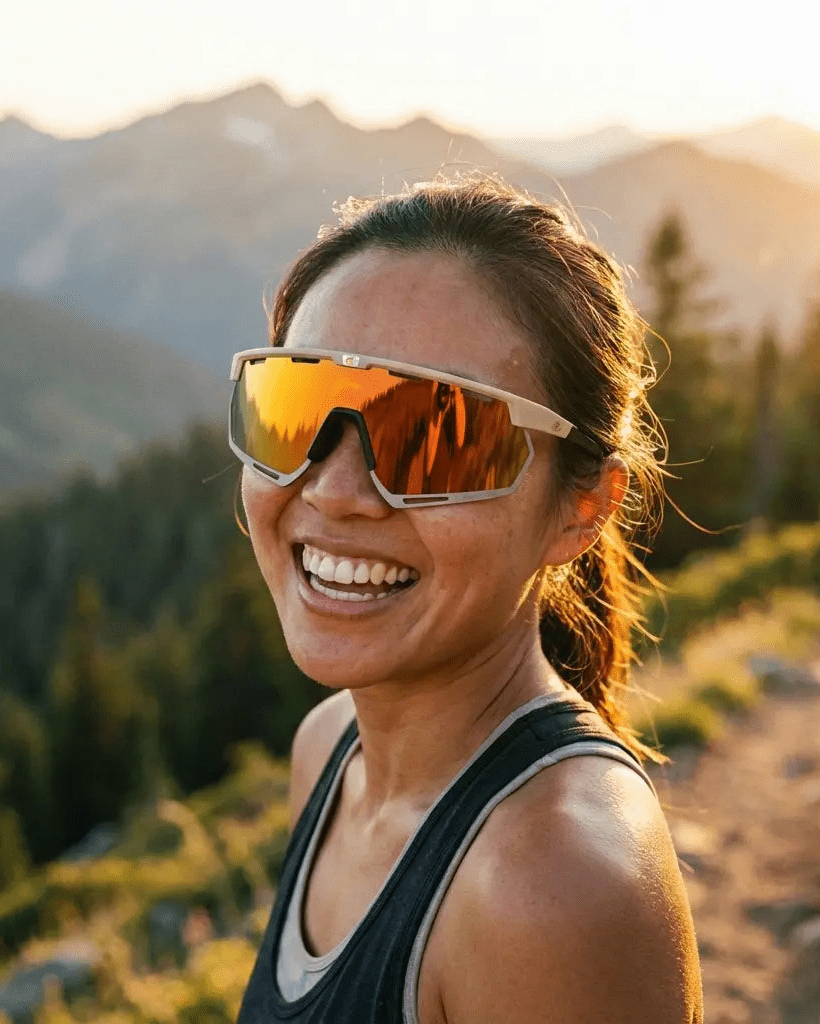
Sunglasses in Singapore need lenses that block ultraviolet light up to 400 nanometres, the specification usually printed as UV400 or described as "blocks 100% of UVA and UVB". That is the only number that matters for eye protection. Lens darkness, mirror coatings, brand name and price tell you nothing about it. A cheap clear lens with UV400 protects your eyes better than an expensive dark lens without it, and a dark lens with no UV filter is actively worse than wearing nothing, because your pupils widen behind the tint and let more ultraviolet in. Here is what to look for, why it matters more here than almost anywhere, and how to check the pair you already own.
In this article
- What does UV400 actually mean?
- Why does sunglass UV protection matter more in Singapore?
- Are darker lenses better at blocking UV?
- Is polarisation the same as UV protection?
- How do I check if my sunglasses block UV?
- Three UV-protective pairs to start with
- FAQ
What does UV400 actually mean?
Ultraviolet light is measured in nanometres. UVB sits roughly between 280 and 315 nanometres, UVA between 315 and 400. A lens rated UV400 filters everything up to that 400 nanometre ceiling, which covers the entire UVA and UVB range reaching the ground. There is nothing above UV400 to buy. It is the ceiling, not a tier.
This is why "UV400" and "100% UVA and UVB protection" mean the same thing. If a seller uses neither phrase and instead says something vague like "UV coated" or "sun protection", treat that as a red flag and ask for the specification.
One more thing worth knowing: UV protection comes from the lens material or a treatment applied to it, not from the tint. That is why the two are completely independent, and why the next section catches so many people out.

Why does sunglass UV protection matter more in Singapore?
Because of where we sit. Singapore is roughly one degree north of the equator, which means the sun passes close to directly overhead for most of the year. UV takes the shortest possible path through the atmosphere, so less of it gets scattered before it reaches you. The National Environment Agency reports that UV levels here frequently reach the Very High or Extreme bands between 11am and 3pm.
Compare that to a temperate country, where the sun sits at an angle for much of the year and the UV index only spikes for a few weeks each summer. In Singapore the exposure is year-round and it is at its worst during exactly the hours most people are outside: the lunch walk, the school run, the afternoon on the court.
The damage is cumulative rather than dramatic. The American Academy of Ophthalmology links long-term UV exposure to cataracts, pterygium (the growth on the white of the eye sometimes called surfer's eye) and photokeratitis, which is essentially sunburn of the cornea. None of these arrive after one bright afternoon. They accumulate over decades, which is exactly why a daily habit matters more than an expensive pair.
Are darker lenses better at blocking UV?
No, and this is the single most common misunderstanding in eyewear.
Tint controls visible light. UV filtering controls invisible light. They are produced by different things in the lens and they do not correlate. You can buy a very dark lens with zero UV protection, and you can buy a lightly tinted or even clear lens with full UV400.
The reason an untreated dark lens is genuinely worse than no sunglasses is simple. In bright light your pupils constrict, which naturally limits how much light enters the eye. Put a dark lens in front of them with no UV filter and your pupils open back up, because the eye reads the scene as dim. Now you have wide pupils admitting the full ultraviolet load. You have removed the body's own defence and replaced it with nothing.
Practical takeaway: never buy unbranded sunglasses from a street stall or a marketplace listing that will not state a UV specification. The tint is not evidence of anything.
Is polarisation the same as UV protection?
No. These are two separate features that often ship together but do not have to.
Polarisation is a filter that cuts glare reflected off flat surfaces: wet roads, the sea, car bonnets, glass buildings. It is a comfort and clarity feature. It reduces squinting and eye fatigue, and it makes a real difference driving along the ECP at 5pm or running beside water at midday.
UV protection is a safety feature. It is what stops the radiation reaching the tissue in your eye.
| Feature | What it does | Protects your eyes? | Do you need it? |
|---|---|---|---|
| UV400 | Blocks UVA and UVB up to 400nm | Yes, this is the protection | Always. Non-negotiable. |
| Polarisation | Cuts reflected glare | No, comfort only | If you drive or spend midday outdoors |
| Dark tint | Reduces visible brightness | No, and harmful without UV400 | Preference only |
| Mirror coating | Reflects some light off the lens face | Marginally, not a substitute | Preference only |

UV-protective and polarised at the lowest price we make. Daily-wear shape.
How do I check if my sunglasses block UV?
There is no reliable home test. You cannot see, feel or judge UV filtering by holding a lens up to a window, and the internet tricks involving phone screens or banknotes do not measure ultraviolet. Three things that do work:
- Read the specification. A legitimate seller states UV400 or 100% UVA/UVB on the product page, the tag or the arm of the frame. If nobody will state it, assume it is not there.
- Ask an optical shop to test them. Most optometrists have a UV meter and will run your existing pair through it in under a minute, usually free.
- Check the lens category separately. Category 0 to 4 describes how much visible light the lens blocks, not UV. Category 3 is the standard for bright sunlight and what most Singapore conditions call for. Category 4 is very dark and is not legal for driving in many countries.
If your current pair has no stated specification and no receipt, the honest answer is that you do not know what you are wearing. For something you put in front of your eyes for hours a day, that is a reasonable thing to fix.

Three UV-protective pairs to start with
The best sunglasses for UV protection are the ones you will actually wear daily, because the damage is cumulative. Price is not the variable that matters. Habit is.

Polarised and UV-protective, built to stay put through a run in full humidity.

Carbon fibre frame, so it stays on your face instead of on your head. Non-polarised.
Browse the full sunglasses Singapore collection, or read our piece on why UV risk in Singapore is rising for the climate side of this.
Frequently asked questions
What UV protection should sunglasses have?
UV400, which blocks ultraviolet light up to 400 nanometres and covers all UVA and UVB reaching the ground. Sellers may also describe this as 100% UVA and UVB protection. Anything less specific is not a specification.
Do expensive sunglasses have better UV protection?
Not necessarily. UV400 is a binary standard: a lens either blocks up to 400nm or it does not. Price usually reflects frame materials, lens clarity, polarisation and brand, not the level of UV filtering. A $55 pair with UV400 protects your eyes as well as a $500 pair with UV400.
Can UV damage your eyes on a cloudy day in Singapore?
Yes. Cloud reduces visible brightness far more than it reduces ultraviolet, so an overcast Singapore afternoon can still carry a high UV load while feeling comfortable to the eye. This is the situation where people most often leave their sunglasses at home.
Do children need UV protection sunglasses?
Yes, and arguably more than adults. Children's lenses are clearer, which means more UV reaches the back of the eye, and they typically spend more hours outdoors. Because the damage is cumulative across a lifetime, early habits matter.
Is UV400 the same as polarised?
No. UV400 is eye protection. Polarisation is glare reduction for comfort and clarity. Many pairs have both, but one does not imply the other, so check for each separately.
Protection you will actually wear every day.
UV-protective lenses built for equatorial sun, from $54.90.
Shop sunglasses →Singapore brand. Fast local delivery.
Share:
7 Best Sunglasses in Singapore for National Day 2026 (Tested Outdoors)
How to Choose Ladies Sunglasses in Singapore: Face Shape, Fit and 4 Picks for 2026